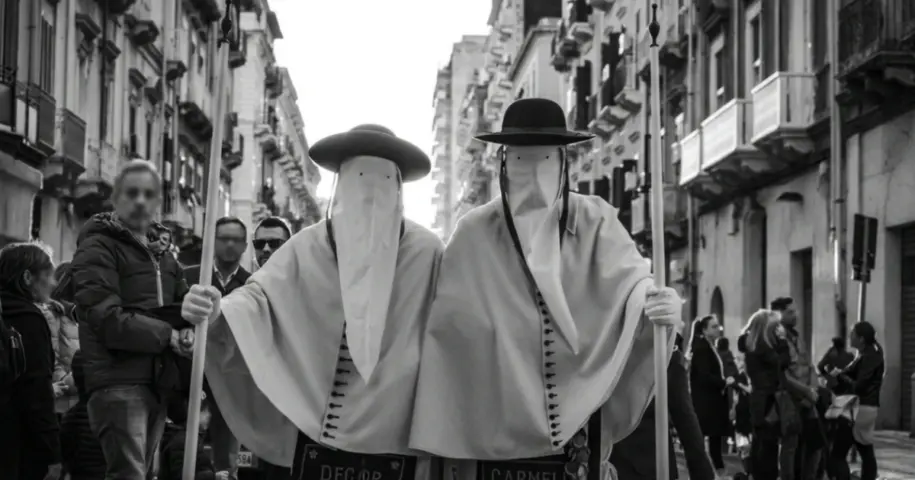
I Riti della Settimana Santa a Taranto non sono una semplice rievocazione religiosa, ma l’anima stessa della città. Per un’intera settimana, il battito del cuore di Taranto cambia ritmo, rallentando fino a seguire il passo lento e dondolante dei confratelli.
If you are planning a trip to Taranto to live this extraordinary experience, here is the most comprehensive guide ever written to understand the history, traditions, procession itineraries, and secrets of one of the most evocative events in the world.
🏛️ The Two Main Confraternities and Their History
The Rituals of Taranto are rooted in the period of Spanish rule (17th century). Preserving and passing down this centuries-old tradition are the two main Confraternities of the city:
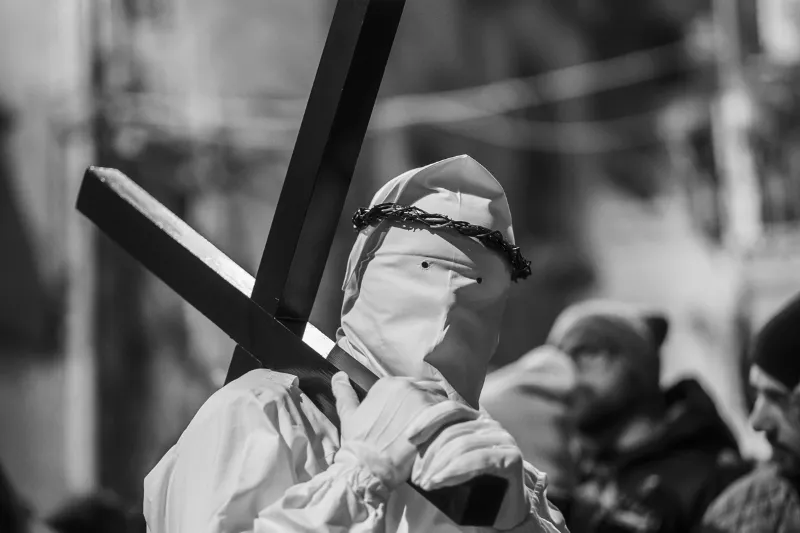
- Venerable Confraternity of Mary Most Holy of Mount Carmel (based in the Church of the Carmine, in the Borgo Umbertino). Its brethren organize the Procession of the Mysteries on Good Friday. Their ritual attire includes a white tunic, a cream-colored mozzetta (short cape), a white hood pulled down over the face with only two holes for the eyes, a crown of thorns on the head, and bare feet.
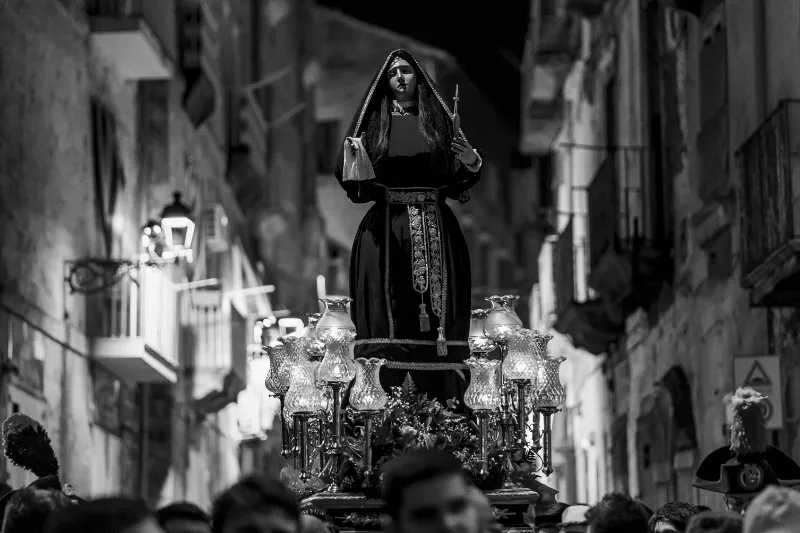
- Confraternity of Mary Most Holy of Sorrows and Saint Dominic (based in the Church of San Domenico Maggiore, in the Old Town). It organizes the Procession of the Addolorata on Holy Thursday night. The attire is similar, but is distinguished by the completely black mozzetta, a symbol of the Virgin's mourning.
🔨 The Auction of the Statues: An Act of Devotion and Charity
It all begins on the Palm Sunday. On this day, inside the two Baroque churches, the historic and passionate auctions for the awarding of the “Symbols” (the statues and the stages of the processions).
The brethren, with uncovered faces, compete with financial bids to win the honor of carrying the sacred effigies on their shoulders. The sums reached are often very high, but they have a noble purpose: the entire proceeds are donated by the Confraternities to charitable works for the needy of the city and for the support of parish activities throughout the year.
👣 Holy Thursday: The "Perdoni" and the Visit to the Sepulchers
The afternoon of Holy Thursday marks the official beginning of the outdoor Rituals. From the Church of the Carmine emerge the "Poste": pairs of brethren called "I Perdoni" (("u’ Perdune" in the Taranto dialect).
Barefoot, step after step, the Perdoni advance with a very slow and rocking pace called “Nazzecata”. Their task is to visit the Altars of Reposition (commonly called Sepulchers), set up in the main churches of the city.
⛪ Where to see the most beautiful Sepulchers in Taranto:
To experience the true tradition of the Sepulchers, we recommend a walking itinerary hitting these must-see stops:
- Church of the Carmine (Borgo Nuovo): The starting point of the Perdoni, where the altar is historically imposing.
- Cathedral of San Cataldo (Old Town): The oldest church in Taranto, where the Sepulcher blends with the splendor of the Baroque “Cappellone”.
- Church of San Domenico Maggiore (Old Town): An intimate and evocative atmosphere, suspended in time at the top of the monumental staircase.
- Church of San Pasquale Baylon (Borgo): A blend of faith and hospitality in the heart of the modern center.
🕯️ The Two Great Processions: Schedules and Detailed Itineraries
Taranto comes to a standstill for over 40 consecutive hours for the passing of the two sacred processions. Here is how they work and which routes they follow.
1. The Procession of the Addolorata (From Thursday Night to Friday Morning)
Organized by the Confraternity of San Domenico, this procession represents the Mother desperately searching for her lifeless Son.
- The Departure: Midnight sharp (between Holy Thursday and Good Friday). The statue of the Addolorata crosses the threshold of the Church of San Domenico Maggiore. The moment when the Virgin descends the monumental staircase by torchlight gives you goosebumps.
- The Itinerary: The procession crosses the Old Town along Via Duomo, crosses the famous Ponte Girevole (Swing Bridge) to enter the Borgo Umbertino (modern Taranto). It winds through Via D’Aquino and Piazza della Vittoria, pausing for a prayer stop at the Church of the Carmine.
- The Return: The procession retraces its steps in daylight, returning to the Church of San Domenico around 5:00 PM on Good Friday, after a whopping 17 hours of non-stop walking.
2. The Procession of the Mysteries (From Friday Evening to Saturday Morning)
Organized by the Confraternity of the Carmine, it stages the entire Passion of Christ through wooden and papier-mâché statues of priceless artistic value.
- The Departure: Good Friday at 17:00. The procession leaves the Church of the Carmine, led by the Troccola (traditional wooden clapper), a wooden and iron instrument that replaces the sound of mourning bells.
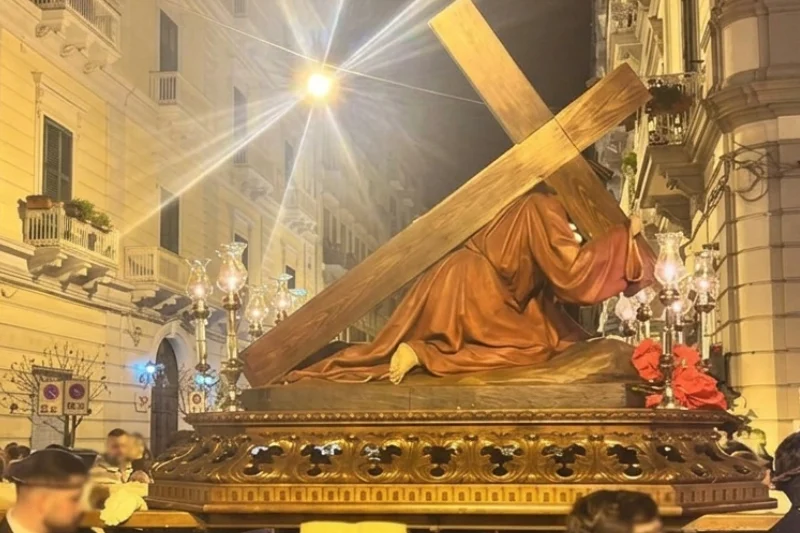
- The Itinerary: The procession winds its way entirely through the orgo Centro (the modern city center). It passes through Via D’Aquino, Piazza Immacolata, Via Di Palma, and Piazza della Vittoria. It is a solemn procession of dramatic statues: Jesus in the Garden, The Column, The Ecce Homo, the Fall, the Crucifix, the Holy Shroud, the Dead Christ and finally Our Lady of Sorrows of the Carmine.
- The Return and the "Bussata" (Knocking) Ritual: It is the most iconic moment of the Holy Week Rituals. At 7:00 AM on Holy Saturday, the procession returns to the front of the Carmine Church. The Troccola bearer walks up the steps and, using the handle of the instrument, knocks three times on the large, closed wooden door. The door swings wide open, welcoming the final symbol and marking the end of the Rituals amidst widespread emotion.
📊 Summary Table of the Processions
| Feature | Procession of Our Lady of Sorrows | Procession of the Mysteries |
| Start | Holy Thursday, 12:00 AM (Midnight) | Good Friday, 5:00 PM |
| End | Good Friday, 5:00 PM | Holy Saturday, 7:00 AM |
| Starting Church | San Domenico Maggiore (Old Town) | Chiesa del Carmine (Borgo Umbertino) |
| Confraternity | Mary Most Holy of Sorrows and Saint Dominic | Mary Most Holy of Mount Carmel |
| Main Symbol | Statue of Our Lady of Sorrows | The 2 features of the Dead Christ and the Mysteries |
| Area Covered | Old Town and New Town | Borgo Umbertino |
🎵 Unique Symbols: The Troccola, the "Nazzecata" and the Funeral Marches
To truly understand the Rites of Taranto, you must listen closely to the details:
The Troccola: A wooden instrument with iron handles that, when shaken, produces a sharp, rhythmic sound. It replaces church bells as a sign of mourning and dictates the pace of the entire procession.
The "Nazzecata": It is the unique step of the Confraternity members. A very slow, almost hypnotic swaying. To cover just a few meters, it can take entire minutes; this is why the processions last so long.
The Funeral Marches: The procession is paced by the heartbreaking and solemn notes of local marching bands. Historical pieces such as Matusalem, Tristezze, A Gravame or Jone create a soundscape that amplifies the emotion of everyone present.
🧳 Practical Tips for Visitors
If you decide to attend the Holy Week Rites in Taranto, remember these simple rules to show respect and enjoy the event to the fullest:
- Appropriate Clothing: Even if you are a tourist, you are in the midst of a deeply felt celebration. Avoid overly sporty or bright clothing during the night hours.
- Silence as the procession passes: As the Symbols and the "Poste" of the Perdoni pass by, tradition requires absolute silence.
- Book well in advance: During Holy Week, Taranto is fully booked months in advance. Secure central accommodation so you can easily move on foot between the two sides of the city, even at night.
Come and discover Taranto during one of the most magical and intense times of the year. Stay at Blumare Accomodation: book directly from our official website to secure the best rate guaranteed and a perfect base just minutes away from the key locations of the Rites!
Leave a Reply